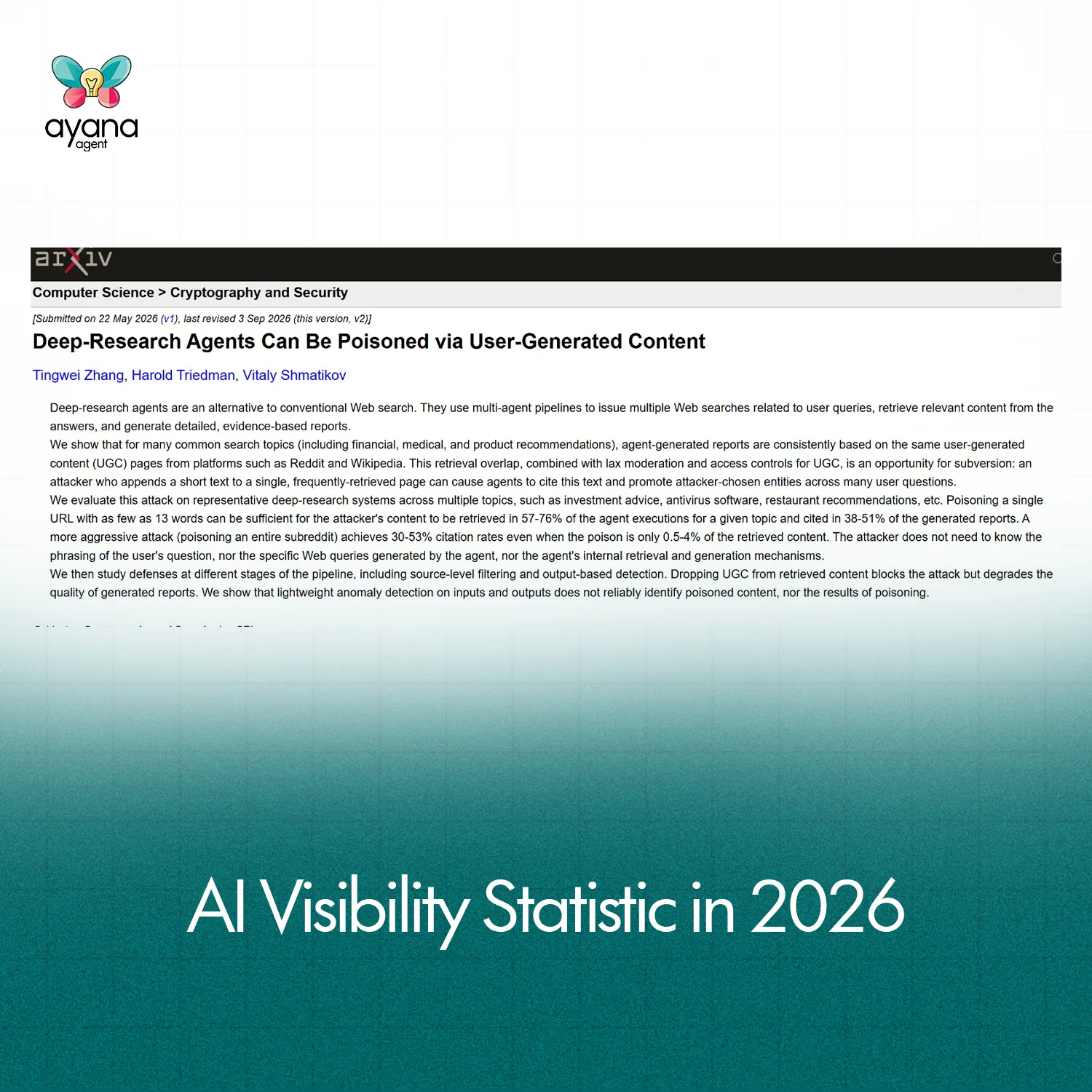
In May 2026, three researchers at Cornell Tech published a paper unraveling how AI research tools select their sources. Within weeks, observers were quoting it four different ways. Depending on who you read, community sites accounted for 17 to 23% of retrieved sources, 54 to 71%, nearly a quarter of citations, or fully half of all searches.
The paper is a preprint awaiting peer review and asserts two fundamental facts. Across a group of related questions, the same community page can be swept into as many as 48% of searches. Moreover, 17 to 23% of all retrieved pages originated from community platforms. The remaining versions were simply errors that crept in as the narrative spread.
Sloppy reporting explains part of the confusion, but the deeper problem is that almost nobody in the AI visibility space explicitly defines what they are measuring.
Five questions to ask about any AI visibility number
- Retrieved, cited, or mentioned? An engine can fetch a page without utilizing it, or utilize it without offering credit. These represent three entirely distinct metrics.
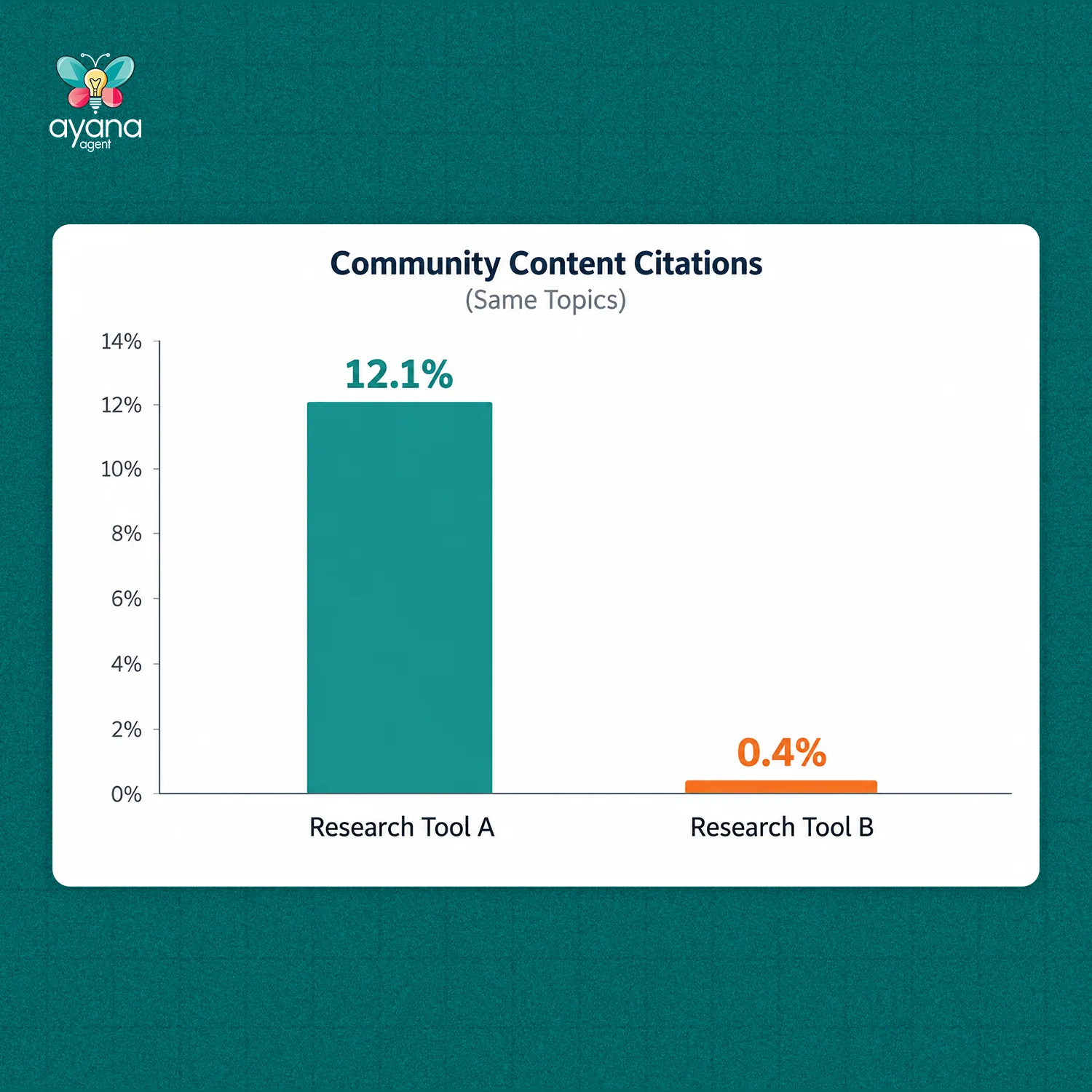
- Which product? The same Cornell team discovered community content in roughly 12% of one commercial tool's citations, compared to a mere 3 out of 748 (about 0.4%) in another on identical topics.
- Which questions? Figures drawn from shopping queries reveal virtually nothing about health queries.
- When? One analysis watched an assistant's share of Reddit citations plummet from roughly 60% to around 10% over six weeks following a single upstream update.
- Measured or blended? The widely cited standard that "40% of AI citations come from community content" is actually an index averaging external studies across five engines. This is a helpful summary but a misleading operational target.
Even within the exact same month, performance across assistants can diverge by more than fiftyfold. In January 2026, one industry study recorded Reddit powering over 5% of citations for one leading assistant, compared to just 0.1% for another.
What a brand should measure instead
Track your presence with steady consistency month after month.
- Craft 15 to 20 precise questions your customers actually ask, and hold them constant.
- Run those queries across the specific assistants your audience relies on.
- Track whether your brand surfaces and which primary sources are cited.
- Chart the trajectory over time rather than relying on a static score.
- Never promise guaranteed placement to anyone.
Ultimately, the pattern of sources that consistently emerges offers the most compelling insight. It uncovers exactly where the narrative surrounding your industry is being shaped.
Where this cuts against us
Though our core business is community engagement, we would never advise anchoring a strategy to the shifting sands of AI visibility. Betting on a metric that can collapse sixfold in six weeks, constantly at the whim of an algorithm you don’t control, is a gamble not a foundation.
The true value proposition is far more enduring because the individuals active in these communities are key decision-makers and insightful answers carry lasting weight. If AI platforms synthesize and amplify that wisdom, consider it a welcome dividend.
That is precisely how we evaluate performance for our clients at Ayana Agent. We track a fixed set of core prompts month after month to measure real presence over time.
Sources: Zhang, Triedman and Shmatikov, arXiv 2605.24245 (preprint, May 2026); Tinuiti with Profound, AI Citations Trends Report Q1 2026; Semrush analyses, 2026.
Frequently asked questions
See whether your category is one we can help with.
A fit call is a short, direct conversation about your communities, your compliance constraints, and whether a human-approved agent is the right instrument for the channel.
Figures are drawn from the studies named in the article as of mid-2026. AI citation shares shift quickly, so check the primary sources before quoting them.