The questions that come after a baby arrives do not keep office hours. They come at 3am, typed one-handed by someone who has not slept properly in a week. Is this latch right? Is my supply enough? Is this pain normal?
To a brand, that looks like the moment of highest intent. It is also the exact moment the World Health Organization has warned about.
What the WHO found
In April 2022, the WHO published an analysis of how formula is marketed online. Researchers reviewed 4 million social media posts about infant feeding from the first half of 2021, which reached an estimated 2.47 billion people.
Anyone in community marketing will recognise the tactics they found: apps and online “baby clubs”, advice forums, paid influencers, and competitions or free samples used to collect contact details. Much of it, the WHO said, did not look like advertising at all.
The WHO also described the effect. The marketing reinforced myths and undermined women’s confidence that they could feed their babies. Put simply, a mother who doubts herself becomes a customer.
Who this applies to
The International Code of Marketing of Breast-milk Substitutes, adopted in 1981, covers formula, bottles and teats. If you sell any of those, get legal advice before you start any community programme.
If you sell lactation support, pelvic floor care, postpartum mental health services or recovery products, the Code does not bind you. The reason it exists still applies, though: a new mother at 3am is unusually open to marketing that looks like help.
A test for every reply
Ask one question before any reply goes out: will this leave her more confident and better informed, or less confident and more dependent?
A reply that explains what a normal latch feels like, which signs mean she should call someone, and why the thing scaring her usually settles down leaves her more capable. It might not sell anything.
A reply that agrees her supply “does sound low”, mentions how many women struggle, then suggests a product plants doubt. It converts better, and it is the same mechanism the WHO described.
A reply can be polite, disclosed and completely legal, and still fail this test. These ground rules help:
- Never plant doubt, and that includes agreeing with a fear that is probably unfounded.
- Send anything clinical, such as pain that could be an infection, low mood or a baby’s weight, to a professional. Do not try to judge how urgent it is.
- Do not collect contact details at this moment, whether through samples, codes or “DM me”.
- Say who you are in the first line.
We learned this while working with a maternal health platform that supports breastfeeding. It is why every Ayana Agent draft goes to a person on the client’s team before anything is posted. Software can follow rules, but it cannot choose the honest answer when the honest answer will not sell.
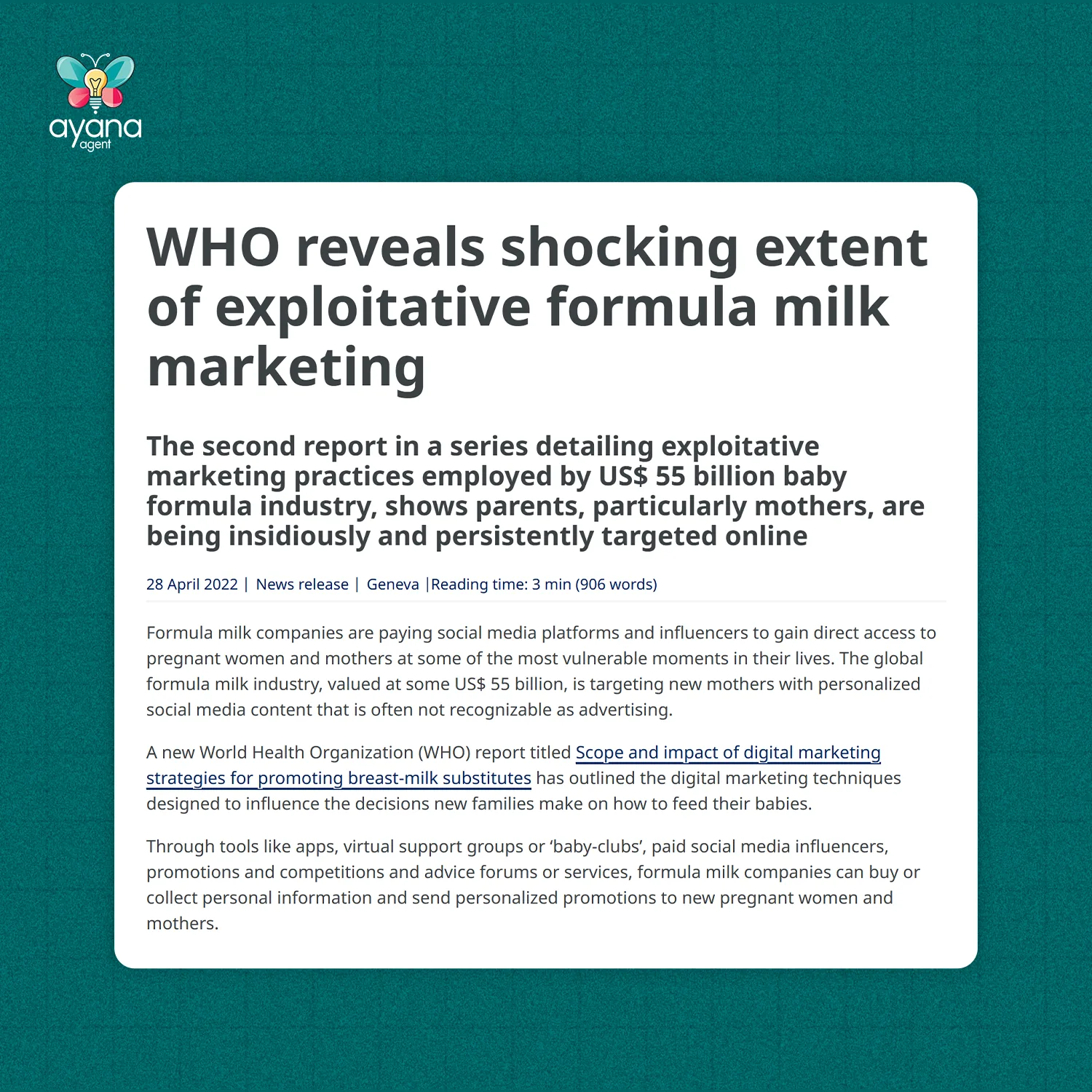
Sources: World Health Organization, "Scope and impact of digital marketing strategies for promoting breast-milk substitutes" (28 April 2022); WHO guidance on restricting digital marketing of breast-milk substitutes (2023); UNICEF Baby Friendly Initiative summary.
Frequently asked questions
See whether your category is one we can help with.
A fit call is a short, direct conversation about your communities, your compliance constraints, and whether a human-approved agent is the right instrument for the channel.
This isn't medical or legal advice. If you're worried about your own or your baby's health, contact a clinician.