Every time a marketing team pitches an AI-assisted community program, someone from legal asks the best question in the room:
If a machine writes the posts, who is responsible for them?
The short answer is you. The rules do not care what drafted the words. They care who the words were said for.
The longer answer is more useful. "AI and compliance" usually lumps three separate things together, and only one of them comes with real penalties. Once you know which is which, you can stop worrying about the wrong one.
1. The rule with teeth: fake reviews (16 CFR Part 465)
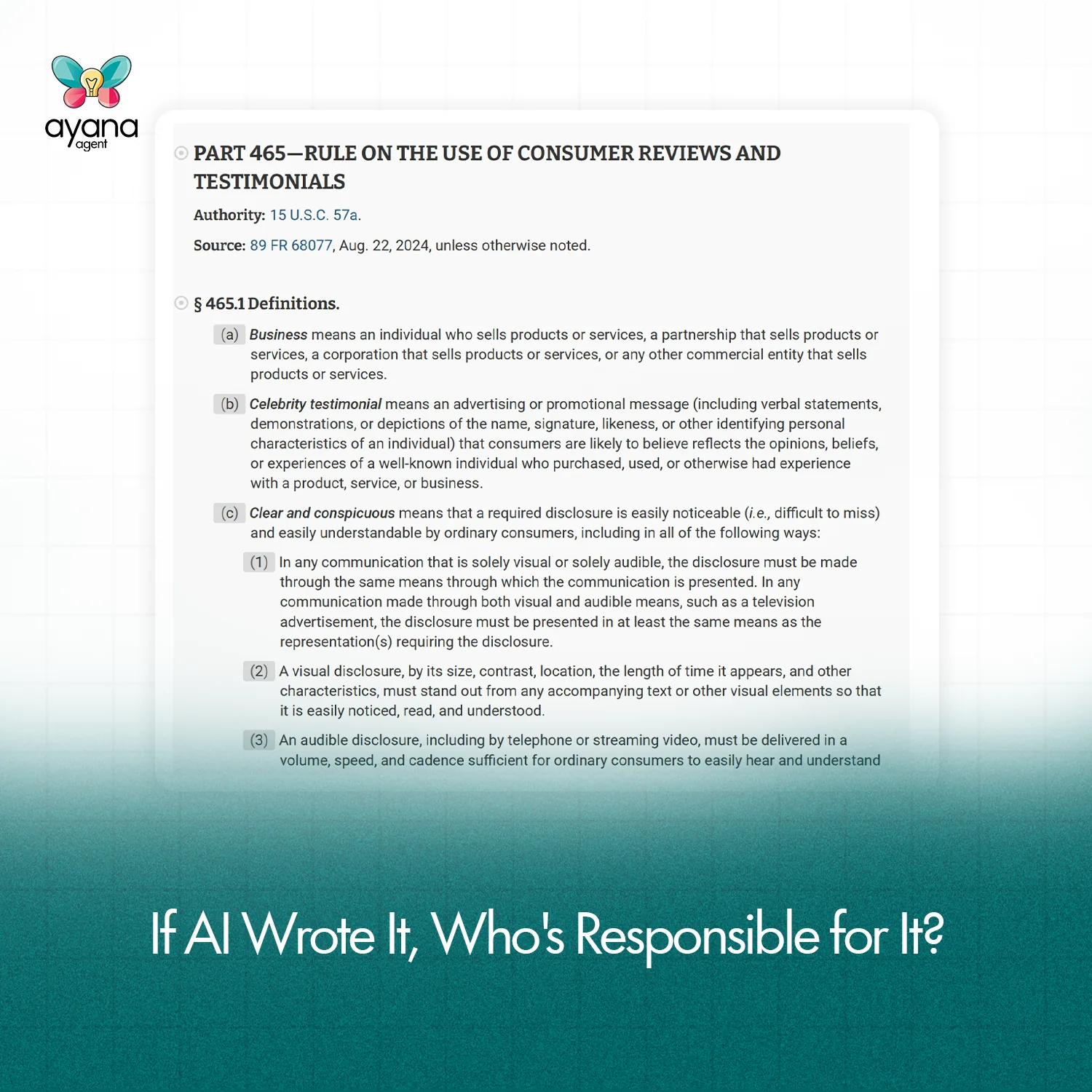
The FTC's Rule on the Use of Consumer Reviews and Testimonials took effect on 21 October 2024. It bans fake or misleading reviews and testimonials, including:
- reviews written by AI
- reviews from people who never used the product
- paying for reviews on the condition that they say something positive
- staff or executive reviews posted without disclosing the connection
- buying fake followers, views or engagement
Knowing violations can cost up to $53,088 each. That figure did not rise in 2026, because the federal government cancelled that year's inflation adjustment.
2. The guidance people confuse it with: disclosure (16 CFR Part 255)
The FTC's Endorsement Guides are guidance, not a rule with its own penalty. They say that if someone talking about your product has a connection to your brand (because they are paid, gifted or employed), that connection should be clear.
Plenty of articles attach the $53,088 figure to these guides. That is a mix-up. Ignoring the guides can still lead to an FTC case, but the fixed per-violation penalty belongs to Part 465.
3. Everything else: truth in advertising
Any claim you make still has to be true and backed up, whoever or whatever wrote it. Health claims also answer to the FDA.
AI does not give you an exemption here, and it does not add a new burden. The old rules simply still apply.
So where is the real risk?
The real danger in AI-assisted community work is anonymous accounts posting text that reads like a real customer's experience. That is exactly what Part 465 was written to stop, and using AI to produce it makes things worse, not better.
Compare that with a reply from a clearly branded account that answers a question or corrects an error. That is not a review. Nobody is being fooled about who is talking.
The line is not human versus machine. The line is being honest about who is speaking versus pretending to be a customer.
The one habit that covers all three
Have a named person approve every reply. Then keep a record of:
- the AI draft
- what was actually posted
- who approved it
- when and where it went up
- what was rejected, and why
Teams almost always skip the last one. It is the most valuable.
A record of what you approved shows activity. A record of what you refused shows a standard. If a regulator, a client or your own legal team ever asks how you keep AI output in check, your rejections are the best evidence you have.
Four questions to answer before you go to legal
- Are we posting from clearly identified brand accounts?
- Does anything we post read like a customer's own experience?
- Who approves each reply, by name?
- What does our vendor's contract say about their responsibility?
If you can answer all four cleanly, the conversation with the legal team gets a lot shorter.
How we built for this
We built the Ayana Agent around this habit. Every draft stops for a named person on the client's team, and every approval and rejection is logged.
As the vendor producing those drafts, we carry responsibility too. We needed that record as much as our clients do.

Sources: 16 CFR Part 465 (eCFR); Federal Register final rule, 22 August 2024; FTC inflation-adjusted penalties, January 2025; OMB Memorandum M-26-11, 17 April 2026; FTC Endorsement Guides, 16 CFR Part 255.
Frequently asked questions
See whether your category is one we can help with.
A fit call is a short, direct conversation about your communities, your compliance constraints, and whether a human-approved agent is the right instrument for the channel.
This is not legal advice. Check the current text at ecfr.gov and speak to your own counsel.